Memory is a poor tool for a time-based problem.
Claes Parflo
This is a personal account of one person's experience tracking health data through a health event. It is not medical advice, and it does not describe what any app or device can do for you. Individual experiences vary.
Once episodes were happening regularly, the instinct was to remember them. Recall the worst nights, reconstruct the timeline, try to identify patterns. That worked for a while.
Then it stopped working.
Memory compresses time. It emphasises the dramatic and blurs the routine. When something happens repeatedly over many months, the details collapse into a general impression that may not reflect what actually occurred. Frequency, duration, timing, context — these things matter when you're trying to understand a pattern, and memory doesn't preserve them reliably.
I realised I was trying to analyse a time-based problem without time-based data.
So the approach changed. Rather than capturing events as free-form notes, I built a simple template — triggered by a shortcut in Apple Notes — that enforced the same structure every time: start time, estimated duration, medication timing, brief context. Not written from scratch each time, but filled in against a fixed format.
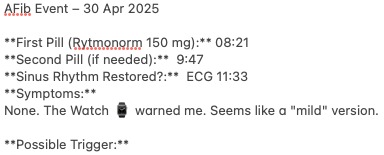
Later, I cross-referenced those notes with Apple Watch data to reconstruct start and end times more precisely, and logged each episode in Apple Calendar as a numbered event. What had been a series of difficult nights became a traceable timeline.
This changed the nature of the problem. The episodes themselves didn't become easier. But they became examinable. I could look at frequency over time, identify clusters, compare duration across episodes, and see whether things were changing. That's a different position to be in than relying on recollection.
The tools were nothing unusual — Notes, Calendar, Shortcuts. The structure was the point. Consistent format meant consistent data. Consistent data made analysis possible.
From Signal to System