The difference between describing a problem and presenting one.
Claes Parflo
This is a personal account of one person's experience tracking health data through a health event. It is not medical advice, and it does not describe what any app or device can do for you. Individual experiences vary.
Once the timeline was structured, the dynamic in those appointments changed.
When a cardiologist asks how things have been, "it happened several times, mostly at night" is not very useful. Being able to say "thirty episodes, ranging from one to fourteen hours, with this distribution over time, here are the ECG recordings" is a different kind of input. It removes interpretation from the exchange. It lets the data speak directly.
The ECG recordings from the Apple Watch played a specific role in this. Every time I met a physician, they wanted to see them — not summaries, but the actual waveforms. They confirmed clearly what was happening and removed any ambiguity about the nature of the episodes. That changed the conversation from description to documentation.
To reconstruct episode timelines accurately, I built scripts that combined Apple Watch data with the structured notes. Start time, end time, duration — logged consistently, cross-referenced, and compiled into a format that could be reviewed and discussed.
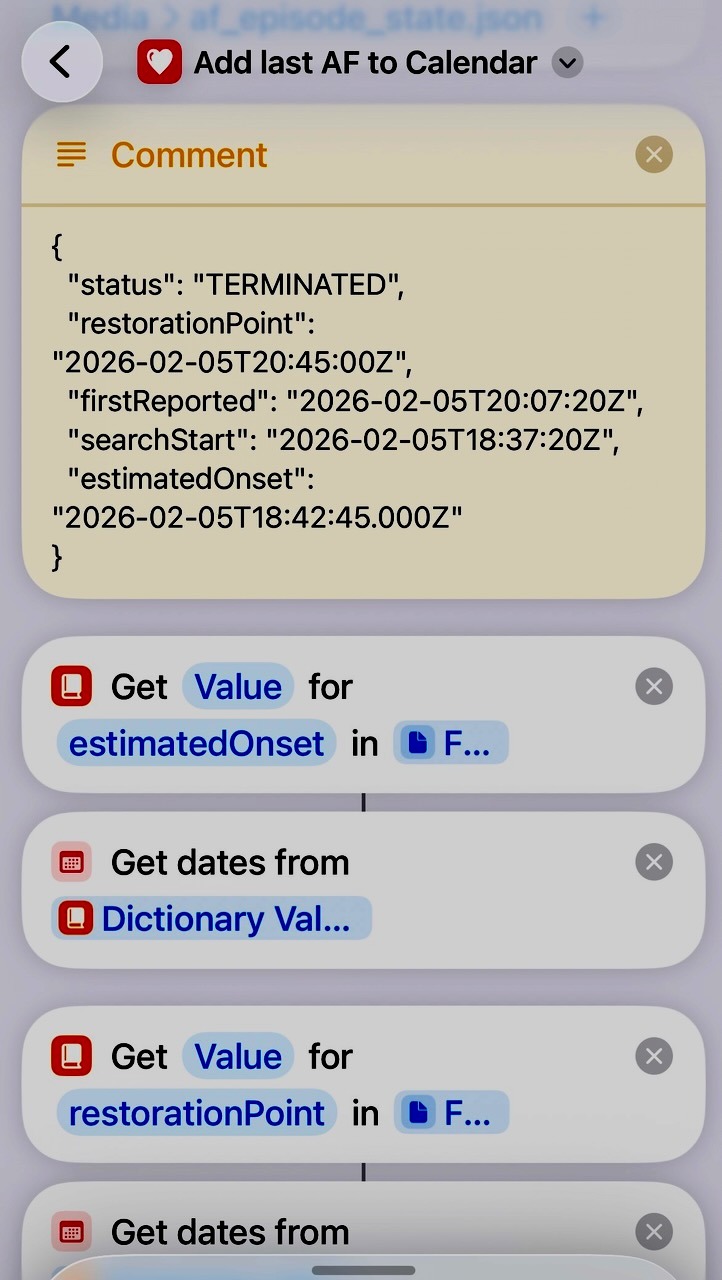
Over time, this created something qualitatively different from a journal. A journal records experience. What I had was an instrumented record: structured, timestamped, cross-referenced, and reviewable.
In engineering, instrumentation means adding measurement to a system so you can understand its behaviour from the inside. That's what this had become. Not just observing that something was happening, but building the infrastructure to capture what was happening precisely enough to be useful.
The practical outcome was that decisions about treatment — including the eventual decision to proceed with an ablation procedure — were made against a documented record rather than subjective recollection. Not because structured data produces better outcomes by itself, but because it supports better-informed decisions at every stage.
From Signal to System